Bibb County's subtropical climate generates prolonged reproductive cycles for predatory stinging insects. In older architectural structures common to the Vineville Historic District and Intown Historic District, deep…
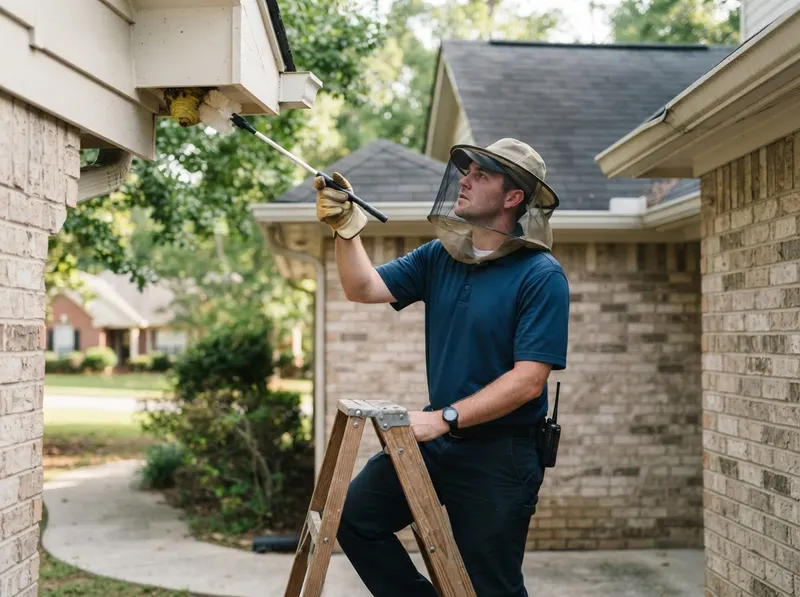
Bibb County's subtropical climate generates prolonged reproductive cycles for predatory stinging insects. In older architectural structures common to the Vineville Historic District and Intown Historic District, deep soffits, tongue-and-groove porch ceilings, and louvered attic vents provide ideal voids for paper wasps and European hornets. Meanwhile, residential lots in Shirley Hills and Northwoods feature dense tree canopies and mature pinestraw beds where subterranean yellowjackets excavate abandoned rodent burrows. Queen wasps emerge from winter harborage beneath loose bark or exterior trim in late March, constructing paper nests out of masticated wood fibers that expand up to several thousand individual workers by August. These stinging insects present direct health hazards through defensive envenomation when mechanical vibrations from lawn care or foot traffic trigger pheromone-driven alarm responses near building perimeters.
Effective perimeter defense differs significantly between exposed paper structures and subterranean or wall-void colonies. Exposed paper wasp combs beneath modern rooflines in Suburban Woods or Cherokee Heights require direct knockdown paired with a synthetic pyrethroid deposit on the attachment pedicle to stop rebuilds. Conversely, yellowjacket colonies inside brick weep holes or crawlspace foundation vents in Ingleside and Bellevue require non-repellent insecticidal dust formulations delivered through directional tip micro-injectors. Consumer aerosol cans frequently fail in enclosed voids because pressurized propellants agitate workers into indoor living quarters through drywall cracks or light fixture gaps instead of penetrating the core brood comb. Professional abatement seals structural ingress points following complete colony collapse, providing an engineering barrier that hardware store sprays cannot deliver.
Subterranean yellowjacket extraction follows an objective sequence: first, perimeter mapping isolates active flight trajectories in lawns or pine bark beds; second, low-pressure microencapsulated compounds or direct cryo-agents neutralize the brood chamber without dispersing defensive scouts; third, structural voids receive a physical barrier installation using fine brass or copper mesh over foundation vents to halt re-entry. Ground nests near Lake Tobesofkee or Central City Park recreational parcels often extend 18 to 36 inches below ground surface, making liquid soil saturations ineffective without pressurized subterranean probe equipment.
Every job gets a firm, written price after a free on-site visit.
Tell us about your stinging insect and nest abatement job in Macon and we'll send a clear, written quote, usually the same day.
 ShieldPoint Pest Control